

Most facility managers and business owners spend a lot of time thinking about what’s visible: clean floors, tidy workspaces, well-maintained equipment. But what’s moving through the air inside your building is just as important, and a lot harder to see. Commercial air duct cleaning services address exactly that. The impact on your building, your people, and your bottom line is more significant than most realize.
What Are Commercial Air Duct Cleaning Services, and Who Needs Them?
Commercial air duct cleaning is the professional cleaning of the ductwork, vents, and related components inside a building’s HVAC system. It covers the supply and return ducts that move conditioned air throughout your facility, as well as registers, diffusers, and air handlers.
Unlike a residential home, a commercial property pushes far more air through a much larger system, often around the clock. That means dust, debris, allergens, mold spores, and other contaminants have more opportunity to accumulate inside the ductwork. Over time, that buildup restricts airflow, reduces system efficiency, and circulates through every room in the building.
Commercial air duct cleaning services are relevant to a wide range of properties, including:
- Office buildings and professional suites
- Retail spaces and shopping centers
- Multi-unit residential buildings and apartment complexes
- Schools, healthcare facilities, and government buildings
- Warehouses, restaurants, and industrial spaces
If your building has an HVAC system and people spend time inside it, keeping those ducts clean matters.
How Do Dirty Ducts Affect a Commercial Building?
Air Quality Is Often Affected First
When contaminants build up inside a duct system, they don’t just sit there. Every time the HVAC runs, those particles get pushed back into the occupied spaces of the building. For employees, tenants, or customers who spend hours inside, that means repeated exposure to dust, allergens, and potentially mold spores.
Poor indoor air quality has a real effect on the people inside. Studies have linked it to increased headaches, fatigue, respiratory irritation, and allergy flare-ups, all of which affect how people feel and how productively they work.
Energy Costs Go Up
Restricted airflow forces your HVAC system to work harder to move the same amount of air. That extra effort shows up directly on your energy bill. Regular commercial air duct cleaning helps restore proper airflow, which means the system runs more efficiently and uses less energy to maintain comfortable temperatures throughout the building.
Equipment Wears Out Faster
An HVAC system under constant strain from clogged ducts doesn’t last as long as one that’s been properly maintained. Components like motors, fans, and coils experience more wear when they’re working against restricted airflow. Routine commercial air duct cleaning is one of the more straightforward ways to reduce that strain and extend the life of the equipment.
What Does the Commercial Air Duct Cleaning Process Look Like?
Commercial air duct cleaning is more involved than a residential job, both in scale and method. A professional crew will typically begin with an inspection of the ductwork to assess the level of buildup and identify any areas of concern, such as moisture, visible mold, or damaged duct sections.
From there, the cleaning involves industrial-grade equipment, including high-powered vacuums and agitation tools, to dislodge and extract debris from deep inside the ducts. Supply ducts, return ducts, registers, diffusers, and accessible components of the air handling unit are all addressed.
A thorough commercial job should also include a check of the drain pans and coils. Buildup on those components contributes to the same problems as dirty ductwork, and leaving them out of the process means the job isn’t complete. For properties that also use ductless equipment, pairing duct cleaning with mini split system maintenance covers all the bases.
How Often Should You Schedule Commercial Air Duct Cleaning Services?
There’s no exact answer that applies to every property. The right frequency depends on several factors specific to your building and how it’s used.
A general guideline used by many HVAC professionals is every three to five years for standard commercial spaces. However, the following situations typically call for more frequent service:
- Buildings with high occupancy or heavy daily foot traffic
- Properties in areas with high outdoor dust or pollution levels
- Facilities that have recently completed construction or renovation work
- Buildings where tenants or employees have reported air quality concerns
- Any space where visible dust accumulates quickly around vents and registers
If you’re searching for a commercial air duct cleaning and aren’t sure where your building stands, an inspection is the right starting point. A qualified technician can assess the condition of your ducts and recommend a cleaning schedule that makes sense for your specific property.
It’s also worth thinking about complementary maintenance. For example, commercial dryer vent cleaning is an important safety and efficiency consideration for laundry facilities in multi-unit buildings, and it pairs well with a full commercial air duct cleaning visit.
Ready to Schedule Commercial Air Duct Cleaning Services for Your Property?
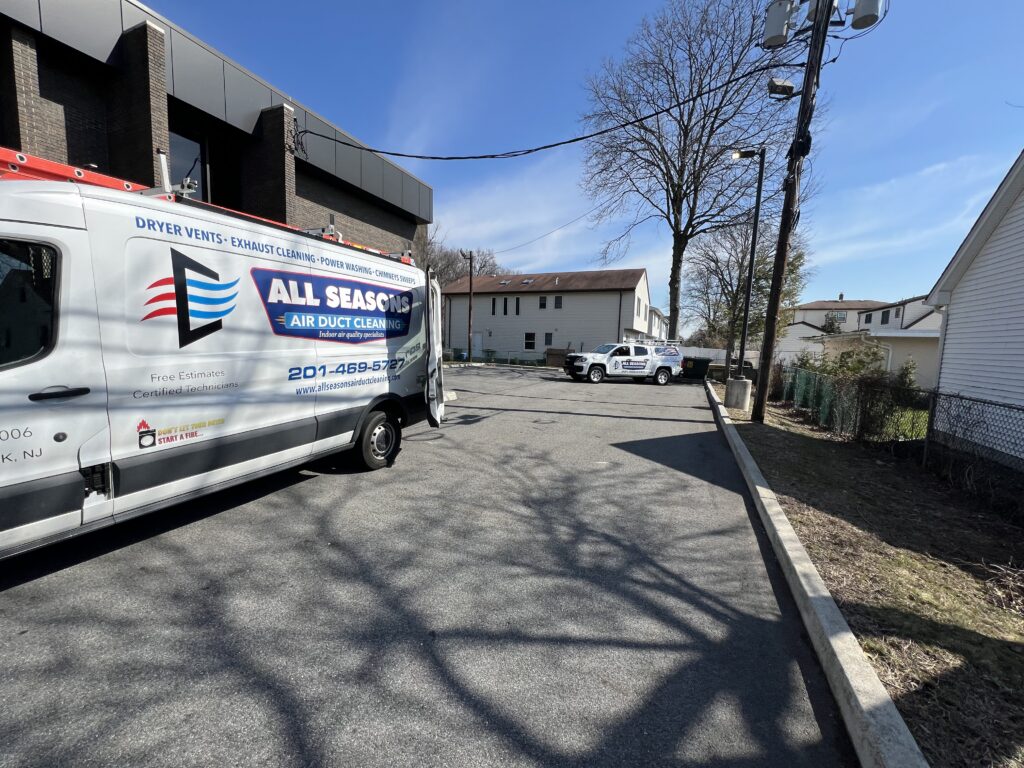
We’ve been serving commercial properties across New Jersey for over 20 years, and we understand what it takes to clean large, complex HVAC systems the right way. Our NADCA-certified team uses professional-grade equipment on every job, and we work efficiently to minimize disruption to your operations. Whether you manage a single commercial space or multiple properties, we bring the same standard of service to every building we work in.
If your ducts are overdue for attention, there’s no better time to get it on the schedule. Visit our commercial air duct cleaning page to learn more, or contact us today to request a free estimate.
Commercial Air Duct Cleaning Services FAQs
Any commercial property with a central HVAC system can benefit, including offices, retail spaces, apartment buildings, schools, restaurants, and healthcare facilities. If people spend time inside the building, air quality matters.
Common signs include visible dust buildup around vents, inconsistent airflow between rooms, unexplained increases in energy costs, and occupants reporting frequent allergy symptoms or respiratory irritation.
It depends on the size and complexity of the system. Smaller commercial spaces may take a few hours, while larger or more complex buildings can require a full day or more.
Professional crews work to minimize disruption. In many cases, service can be scheduled during off-hours or around your facility's schedule to keep interference with daily operations to a minimum.
Yes. Commercial systems are larger, more complex, and typically run more hours per day than residential systems. The equipment, process, and scope of work are all scaled accordingly.
Removing debris from ductwork restores proper airflow, which reduces the strain on your HVAC system. A system that doesn't have to work as hard to move air uses less energy, which can lower monthly operating costs over time.
